
Market Discovery and the Evolution of an Early Premier Labs Business Concept
When Premier Labs launched, a deliberate choice was made about where new product ideas should come from: the people closest to customer problems. Operators, technicians, and engineers in the industry as well as project teams inside Premier see firsthand what slows production, what risks go unaddressed, and where manufacturers struggle to keep pace with modern needs.
One of the very first concepts brought to Labs illustrates exactly how our venture studio model works, and why the process matters just as much as the technology behind it.
It began with a simple idea:
What if we could build a better emergency stop button?
And it evolved into something far more powerful.
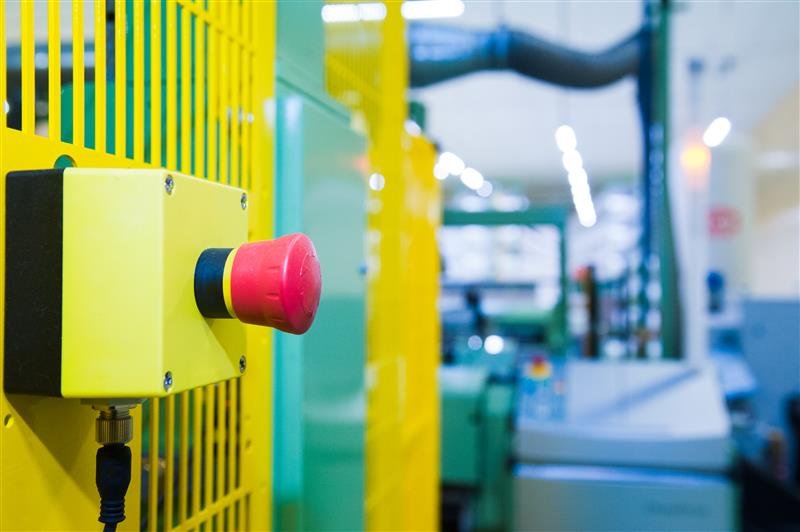
Understanding the E-Stop Problem
The original concept was rooted in a challenge manufacturers see every day: operators can’t be physically present or fully attentive at all times. They step away to manage other tasks, respond to competing priorities, or simply shift focus during a busy production cycle. When that happens, equipment may continue running without the immediate oversight needed to intervene if something goes wrong.
The question that sparked the idea was simple:
Could an emergency stop become smart enough to intervene when an operator isn’t there to do it?
Early brainstorming explored a wide spectrum of possibilities, vision systems that detect whether someone is present, proximity sensors that respond when an operator steps away, even biometric indicators for more hazardous environments. Each idea pointed toward the same goal: creating a device that could automatically recognize when intervention was necessary and shut a process down for safety.
These concepts made the opportunity worth investigating. But to understand whether the idea could become a viable product, and what form it should take, Labs needed to move beyond early assumptions and into structured discovery.
Discovery That Changed the Trajectory
Joel Reed, President of Premier Labs explains an essential part of the Lab’s approach, “As with any new concept at Premier Labs, our team began with structured due diligence. This means validating the problem, exploring potential solution paths, and assessing what type of market the idea might enter.” During this process, one thing quickly became clear: an E-stop is fundamentally a mechanical component, sold through commodity channels at commodity pricing.
A “smarter” version would still place the idea in that same category, selling a device, not solving a broader operational challenge. That market position carried limitations that didn’t align with the value Labs aims to create.
While many conversations confirmed the initial problem, operators stepping away or dividing attention, they also revealed a deeper constraint. Manufacturers emphasized the rigid one-to-one relationship between a single operator and a single machine. One interviewee put it plainly:
“Your E-stop idea is interesting, but what I really want is to turn one operator into five.”
That insight reframed the entire opportunity. The issue wasn’t just that equipment needed a smarter way to stop. The larger challenge was enabling one operator to safely and effectively oversee multiple stations — something the original concept didn’t address.
According to Reed, this is a unique differentiation between Labs’ initiatives and companies founded by visionary founders. “Because Labs evaluates ideas early, before engineering begins, we have the ability – if not a mandate – to pivot based on what the market actually needs.” This is exactly why the Labs process exists: to let real-world insight guide the direction, not preconceived assumptions.
“Because Labs evaluates ideas early, before engineering begins, we have the ability – if not a mandate – to pivot based on what the market actually needs.”
Reframing the Solution
While the full details of the new direction remain confidential, what can be shared is how profoundly the concept shifted. Instead of pursuing a smarter mechanical device, Labs moved toward an enterprise-level systems solution — one that uses advanced technologies to improve how human workforces interact with the equipment they manage.
The revised concept focuses on giving manufacturers greater flexibility, better visibility into operations, and more control across their production environments. It aligns directly with broader industry pressures, including labor shortages and the need to scale human oversight more efficiently.
In short, the idea evolved from a commodity hardware component to a software-driven platform designed to address meaningful, bottom-line challenges for industrial producers. And while this work remains in active development, the transformation of the concept reflects exactly what Premier Labs was built to do: uncover the real problem and pursue the opportunity with the greatest impact.